Understanding Lash Curl: More Than Just a Curve
When designing a set of eyelash extensions, curl selection is one of the most influential decisions an artist makes. It determines how an extension projects from the natural lash, the degree of visible lift it creates and the overall direction of the finished set.
However, selecting a curl should never be based solely on how dramatic or lifted a particular profile appears.
A technically successful application requires an understanding of how the extension's curvature interacts with the client's natural lash direction, eyelid structure and desired styling outcome. The same curl can produce noticeably different results depending on these variables.
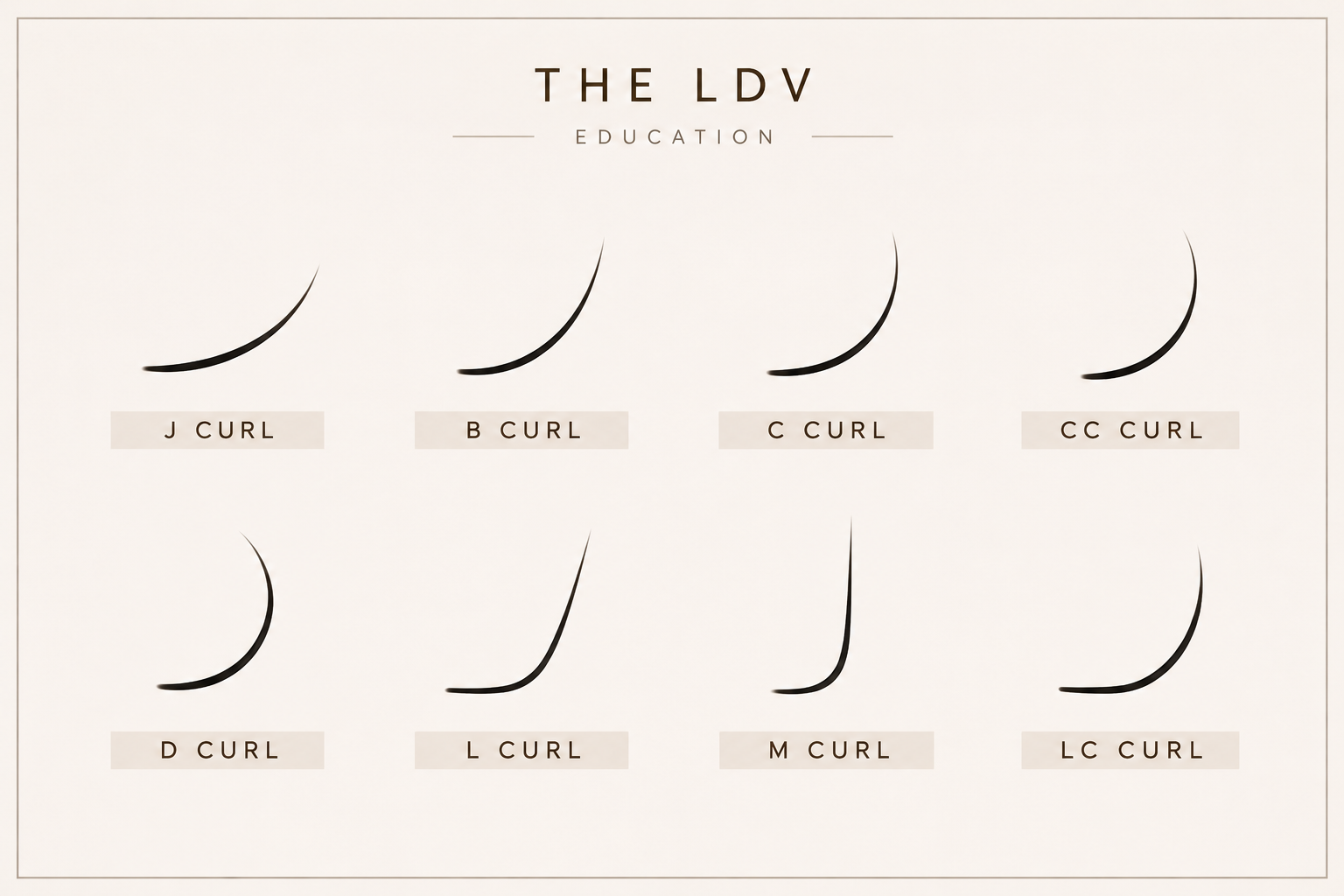
From the understated profile of a J curl to the pronounced lift of a D curl and the distinctive geometry of the L family, each profile offers different possibilities for lash design.
Understanding these distinctions allows artists to move beyond selecting curls by preference and begin using them as intentional styling tools.
The Different Types of Eyelash Extension Curls
J Curl — Minimal, Natural Definition
J curl is one of the straightest conventional lash profiles, featuring a very subtle curvature towards the tip. Its understated shape creates minimal additional lift, making it suitable for natural-looking applications where the intention is to maintain a relatively soft silhouette.
Styling characteristics:
Very subtle curvature.
Minimal visible lift.
Creates a restrained, natural-looking finish.
Maintains a relatively straight extension profile.
J curl is particularly useful when a client wants definition without a noticeably curled appearance. Its relatively straight profile should, however, be assessed against the direction of the natural lash to ensure the extension does not create an undesirable downward visual effect.
B Curl — Soft, Subtle Lift
B curl introduces a slightly more pronounced curvature than J curl while maintaining a natural-looking profile. It offers a gentle transition from the base towards the tip, creating soft definition without an exaggerated upward projection.
Styling characteristics:
Gentle, gradual curvature.
Subtle visible lift.
Natural-looking definition.
A softer alternative to more pronounced conventional curls.
B curl is often selected for understated classic applications and softer lash designs. It is particularly useful when the desired result involves enhancing the natural lash rather than dramatically changing its direction.
C Curl — Balanced, Versatile Definition
C curl is one of the most versatile conventional profiles, offering a balanced curvature that creates noticeable lift without appearing excessively dramatic.
Its moderate shape makes it a popular choice across classic, hybrid and volume applications, providing definition while retaining a relatively natural-looking silhouette.
Styling characteristics:
Moderate, rounded curvature.
Balanced upward projection.
Versatile across different styling techniques.
Suitable for natural through moderately defined finishes.
C curl provides an excellent foundation for understanding more pronounced curl profiles. It can be used to create soft everyday sets or incorporated into more intricate designs where controlled lift and definition are required.
CC Curl — Enhanced Lift and Definition
CC curl offers a more pronounced curvature than C curl, creating additional lift and a more defined appearance.
It bridges the space between the balanced projection of C curl and the stronger curvature of D curl, making it useful when an artist wants a more noticeable result without moving immediately into a highly pronounced curl.
Styling characteristics:
Greater curvature than C curl.
More noticeable upward projection.
Creates a more open, defined appearance.
Suitable for more enhanced styling effects.
CC curl is particularly useful for artists who want to introduce additional definition while retaining control over the overall silhouette. Its versatility makes it valuable across both structured and textured lash applications.
D Curl — Pronounced, High-Impact Lift
D curl features a significantly more pronounced conventional curvature, creating a bold, lifted appearance.
Its strong upward projection can dramatically influence the visual character of a lash set, making it useful for applications where a more striking, open-eye effect is desired.
Styling characteristics:
Strong, rounded curvature.
Pronounced upward projection.
Creates an expressive, defined finish.
Particularly noticeable in volume and textured applications.
D curl requires careful consideration of natural lash direction and eyelid clearance. Its stronger curvature can affect how much of the extension's base aligns with the natural lash, so correct attachment compatibility is essential.
A stronger curl does not automatically produce a better result. The objective is to select a profile that complements the client's anatomy while maintaining a technically sound application.
Understanding Speciality Curl Profiles
Unlike conventional curls, the L family features a straighter lower section followed by a more pronounced upward transition. This changes the geometry of the extension and provides additional possibilities for artists working with different natural lash directions and eyelid structures.
L Curl — Straight Base, Defined Lift
L curl is characterised by a relatively straight base that transitions into a distinct upward curve.
This creates a more angular profile than conventional rounded curls, offering a different type of projection and visual lift.
Styling characteristics:
Straighter lower section.
Distinct upward transition.
More angular profile.
Strong directional definition.
L curl can be particularly useful when working with naturally straight lashes or clients whose eyelid structure requires a different approach to conventional curl profiles.
Its distinctive base geometry requires precise attachment and appropriate alignment with the natural lash.
LC Curl — Straight Base, Softer Curvature
LC curl combines the characteristics of a straighter base with a more rounded upper curvature.
It offers an alternative to the sharper transition of a traditional L profile, creating a more blended progression from the base towards the tip.
Styling characteristics:
Relatively straight base.
Softer, rounded upper curvature.
A more gradual visual transition than some L profiles.
Directional lift with a less angular silhouette.
LC curl is useful when an artist wants the structural characteristics of an L-style profile while introducing a softer overall appearance.
M Curl — Directional, Sweeping Lift
M curl features a relatively straight lower section followed by a pronounced upward transition. Depending on the manufacturer's design, its curvature can create a distinctive sweeping effect.
Styling characteristics:
Straighter lower profile.
Pronounced upward transition.
Directional lift.
Distinctive, elongated styling potential.
M curl is a specialist profile that can be used to introduce direction and definition into more advanced lash designs. Its geometry should be considered in relation to the natural lash angle, eyelid clearance and the intended placement within the overall map.
Rather than treating M curl as simply a stronger version of conventional curls, artists should understand its different structural profile.
Comparing the Different Lash Curls
CurlGeneral profileVisual effectJAlmost straightMinimal definitionBGentle curveSoft, natural liftCModerate rounded curveBalanced definitionCCMore pronounced curveEnhanced liftDStrong rounded curveHigh-impact liftLStraight base, sharp transitionAngular liftLCStraight base, softer upper curveBlended directional liftMStraighter base, sweeping transitionPronounced directional lift
These are general profile descriptions. Actual curl geometry varies between manufacturers.
How to Select the Correct Curl for Your Client
Understanding the differences between curl profiles is only the beginning. Advanced lash artistry involves identifying which profile will work most effectively with the individual client's natural features.
1. Assess Natural Lash Direction
Begin by evaluating the direction in which the natural lashes grow.
Some clients have naturally upward-facing lashes, while others have lashes that grow relatively straight or angle downwards. This can influence how an extension sits once applied and how much visible projection it creates.
The extension should be selected to complement the natural lash direction while achieving the intended styling result.
2. Consider Eyelid Structure
The amount of visible eyelid space, the position of the brow bone and the presence of an upper eyelid fold can all influence curl selection.
For example, clients with hooded or monolid eyes may require a different approach to projection than clients with more exposed upper eyelid space.
The artist should assess how the extension will appear from both frontal and side perspectives, ensuring the finished curl has sufficient clearance.
3. Understand the Intended Styling Effect
Before selecting a curl, establish the overall visual objective.
Is the intention to create a soft, natural enhancement? A more open appearance? A lifted outer section? Or a highly textured, dimensional result?
Curl selection should support the styling concept rather than dictate it.
4. Evaluate Length and Diameter Separately
Curl, length and diameter are three distinct characteristics of an eyelash extension.
Length determines the extension's reach, diameter influences its thickness and weight, and curl determines its curvature and direction.
These variables must be considered together. A longer extension with a pronounced curl can create a substantially different result from a shorter extension with the same curl.
Artists must also ensure that the selected diameter and length are appropriate for the condition and strength of the natural lash.
5. Consider Attachment Compatibility
One of the most important technical considerations is how the extension's base aligns with the natural lash.
Different curl profiles create different contact geometries. An extension that does not align appropriately with the natural lash can compromise the quality of the attachment.
Artists should assess the available attachment surface, isolation, placement and alignment rather than assuming that a particular curl will automatically suit a client.
Can Different Lash Curls Be Combined?
Yes. Combining different curl profiles can introduce additional control over direction, projection and texture.
Advanced artists may incorporate more than one curl within a design to create transitions, modify the appearance of specific sections or introduce additional dimension.
However, mixed-curl applications require a clear understanding of how each profile interacts with the natural lash. Inconsistent transitions can produce an uneven silhouette, while poorly matched profiles can compromise attachment compatibility.
The decision to combine curls should therefore be intentional and based on the design objective, rather than simply introducing additional variations.
The Importance of Understanding Curl Geometry
Curl selection is a fundamental part of advanced lash artistry. It influences more than the degree of lift visible in a finished set; it affects the direction, silhouette and structural compatibility of each extension.
An artist who understands the differences between conventional and speciality curl profiles is better equipped to make informed decisions, adapt their styling approach and create more individualised results.
The objective is not to use the curl with the greatest amount of lift. It is to understand the geometry of each profile and select the one that achieves the intended result without compromising the integrity of the natural lash.
At THE LDV, we believe precision begins long before the first extension is applied. It begins with understanding the materials, assessing the natural lash and making deliberate decisions at every stage of the application.
Because exceptional lash artistry is not simply about application. It is about understanding why every decision matters.